From Alarms to Smoke Detection: Building a Complete Security System for New Zealand Properties | ||||
|
A modern security system is no longer just an alarm mounted near the front door. For homes, offices, warehouses and retail properties, effective protection can combine intrusion detection, CCTV, access control, monitoring and fire detection into one practical security strategy. That matters because every property has different vulnerabilities. An Auckland home may need protection around doors, windows and garages, while a commercial building may require controlled access, multiple cameras, alarm zones and after-hours monitoring. The goal is not to install every available device. The goal is to build a system around the property's actual security requirements. For property owners researching security systems in NZ, this distinction can save money and prevent a common mistake: buying equipment first and figuring out the security strategy afterward.
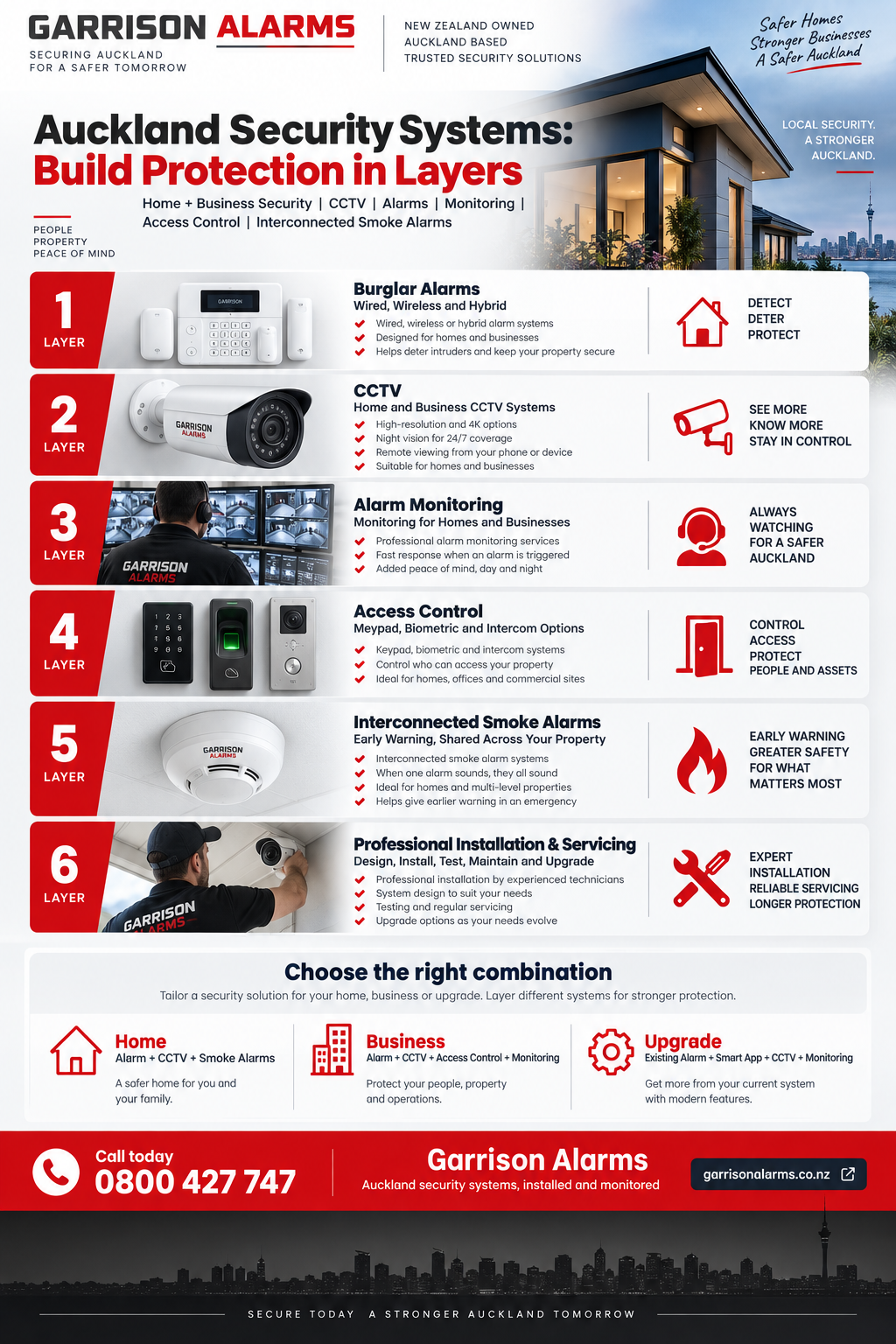
Key Takeaways: What Should a Complete Security System Include?What makes a security system complete? Do homes and businesses need different security solutions? Should security equipment work together? Why is professional installation important? Start With the Property, Not the ProductWalk into a security showroom and you can quickly become overwhelmed by cameras, sensors, alarms, smart hubs and other devices. The better starting point is the property. Ask where people enter, where valuable assets are located, which areas remain unoccupied, which doors need controlled access and where a security incident would be most difficult to detect. Someone searching for the best home security system NZ may assume the answer is a particular alarm or camera brand. In practice, the appropriate system depends on the building, its layout, the owner's priorities and the level of protection required. A small house may need a straightforward alarm and CCTV setup. A larger property may require multiple alarm zones, outdoor cameras, remote access and professional monitoring. The same principle applies to commercial premises. Good security design begins with risk assessment, not product selection. Five Security Layers That Can Work TogetherA useful way to understand modern security is to break it into layers. Each layer solves a different problem, and the strongest system is often the one where those layers complement one another. 1. Alarm DetectionAn alarm provides the basic intrusion-detection layer. Door contacts, window sensors and motion detectors can identify activity in protected areas. Depending on the property, additional detection may be appropriate for garages, gates, restricted rooms or other vulnerable locations. For homeowners considering smart home security NZ, modern alarm systems can also provide remote notifications and management features. The important consideration is coverage. A sophisticated alarm does not compensate for poorly protected entry points. 2. CCTV SurveillanceCCTV answers a different question. An alarm can indicate that an event has occurred. A camera can provide visual information about what is happening. Strategically positioned cameras can cover entrances, driveways, outdoor areas, loading zones, stock rooms and other locations where visibility matters. This becomes particularly useful when building integrated security systems NZ properties can use across multiple security layers. The objective is not to put cameras everywhere. It is to place them where visual information provides meaningful security value. 3. Access ControlSecurity is also about deciding who is allowed inside. A home may simply need controlled access around the main entrance or gate. An office could require different permissions for staff, managers and visitors. A warehouse might need restricted access to storage or equipment areas. Access control can use cards, PINs, intercoms, biometric technology or other methods depending on the system. For businesses planning office security systems in Auckland, companies can expand over time, scalable access control can become an important part of the overall security architecture. 4. MonitoringAn alarm can detect an event, but what happens when nobody is there? That is where monitoring becomes relevant. Professional monitoring can provide another response layer when a property is vacant, particularly during evenings, weekends or business shutdown periods. For homeowners, monitoring can provide additional reassurance while they are away. For businesses, it can complement physical security measures after employees have left the premises. Monitoring should therefore be considered as part of the overall security strategy rather than simply as an optional add-on. 5. Smoke DetectionFire protection deserves a place in the conversation. Security planning sometimes focuses heavily on burglary, cameras and alarms while treating smoke detection as a separate issue. From a property-protection perspective, both intrusion and fire can create serious risks. Smoke detectors can provide early warning, while interconnected smoke alarms can allow multiple detectors to communicate throughout a property. For properties that need dedicated fire detection, Garrison Alarms provides smoke detector NZ solutions as part of its broader security offering. That creates an important distinction: A complete property-protection strategy should consider both security threats and fire safety. Home Security Requires a Different ApproachA residential security system usually begins with the home's access points. Think about the front door, rear entrance, garage, accessible windows, driveway and outdoor areas. Then consider how the household actually operates. Are people regularly arriving late at night? Is the garage connected to the house? Is there a side gate? Are there areas of the property that cannot easily be seen from inside? These details influence security design. A homeowner searching for security systems Auckland properties can use should therefore look beyond generic packages. The useful question is not: “How many cameras do I need?” It is: “Which areas need detection, which areas need visibility, and which areas need controlled access?” That shift in thinking can produce a more practical system. Commercial Properties Have More Moving PartsBusinesses introduce another level of complexity. A small office may need controlled employee access and CCTV around the entrance. A warehouse may need perimeter protection, cameras covering loading areas, alarm zones and restricted access. A retail store may need security around entrances, stock rooms, staff areas and valuable merchandise. That is why warehouse security systems NZ businesses use should be designed around the building's operational environment. The same principle applies to retail security systems NZ businesses require. Security should support the way the business operates rather than interfere with it. For example, an access control system that is difficult for authorised employees to use may create operational problems. A camera system with poorly positioned views may provide footage without providing useful coverage. The best system architecture is therefore closely connected to the property's daily activity. Why Integrated Security Can Be More PracticalImagine an Auckland business receives an alarm notification after closing time. The alarm identifies an unusual event. CCTV can provide visual information. Access control can show which credentials were used at controlled entry points. Monitoring can provide an additional response layer. Each technology contributes something different. That is the practical idea behind an integrated security approach. Rather than treating alarms, CCTV, access control and monitoring as completely independent products, property owners can design them as complementary layers. This can make the system easier to manage and can create a clearer security process. The technology is important, but the relationship between the technologies is where much of the practical value comes from. Professional Installation Is More Than Mounting EquipmentA camera can be technically excellent and still provide poor security coverage if it is positioned incorrectly. The same applies to sensors. Installation involves more than attaching equipment to a wall. The installer needs to consider coverage, access points, building layout, cable routes, power, connectivity, environmental conditions and how the system will be used. For Auckland property owners who need to install security system equipment, professional installation can help ensure the components are configured around the actual property rather than around a generic template. If the next step is a professional assessment or installation, Garrison's alarm installation Auckland service provides a direct path from security planning to implementation. That is particularly useful for property owners who are unsure how many sensors, cameras or alarm zones are actually appropriate. Smoke Alarms Shouldn't Be an AfterthoughtA security discussion often starts with burglary. Fire protection should not be forgotten. Smoke detection provides a different type of protection, and interconnected systems can help distribute an alert throughout a property when one detector identifies smoke. That can be especially useful in larger homes and commercial buildings where occupants may be in different rooms or areas. If you are researching interconnected systems, Garrison's guide to the best smoke detectors and interconnected smoke alarms in NZ provides another resource for understanding the role of smoke detection in a broader property-protection plan. The lesson is straightforward: Security protects more than possessions. A properly planned system can also help protect people. What About the Cost?Security costs depend heavily on the property. The number of doors, windows, cameras, sensors and controlled access points can affect the system. Monitoring, installation complexity, existing infrastructure and future expansion can also influence the final price. That is why requesting a security system quote NZ property owners can actually use for planning is more useful than comparing a single advertised package price. Two buildings can require completely different systems even if they are in the same suburb. A small home may need a compact installation. A warehouse may require extensive CCTV coverage and multiple security zones. A business with several entrances may need access control as well as alarms and cameras. A meaningful quote should therefore connect the recommended equipment to the property's specific requirements. How to Evaluate a Security CompanyWhen comparing a security company Auckland homeowners or businesses can work with, consider the entire service rather than the equipment catalogue alone. Useful questions include:
These questions help separate a product purchase from a complete security service. A security company is ultimately involved in three stages: design → installation → ongoing support. The equipment matters, but those three stages determine how useful the system becomes over time. A Simple Security Audit You Can Do Before Calling an InstallerBefore requesting a quote, walk around your property. OutsideCheck:
InsideCheck:
Business premisesAlso consider:
Fire safetyFinally, review:
This five-minute walkthrough can make a professional consultation much more productive. Instead of saying:
You can explain:
That gives the installer a much clearer starting point. Build for Today's Property—and Tomorrow'sSecurity needs can change. A homeowner may renovate the property. A business may hire more employees. A warehouse may expand. A retailer may add another location. That is why scalability deserves attention before installation. A system that can accommodate additional cameras, sensors, access points or monitoring requirements may be more practical for a growing property than a system designed only around today's needs. This is also why the cheapest initial installation is not automatically the lowest-cost solution over its entire lifespan. Consider the upgrade path. Ask what happens when the property changes. Ask whether additional equipment can be integrated. Ask whether the existing system can be serviced and upgraded. Future-proofing is part of security planning. From Security Equipment to a Security EcosystemThe biggest change in modern security is not simply that there are more devices. It is that those devices can increasingly operate as parts of a larger ecosystem. An alarm provides detection. CCTV provides visibility. Access control manages entry. Monitoring provides an additional response layer. Smoke detection addresses fire-related risk. Smart controls can make management more convenient. The value comes from understanding what each layer is supposed to accomplish. That is the difference between buying security equipment and designing a security system. Choosing the Right Starting PointIf you are a homeowner, begin with your vulnerable entry points and the areas you want monitored. If you operate an office, consider staff access, visitor movement and restricted areas. If you manage a warehouse, look at loading areas, perimeter access, stock zones and after-hours protection. If you operate a retail business, consider entrances, stock rooms, staff areas and customer-facing spaces. Then determine which combination of alarms, CCTV, access control, monitoring and smoke detection makes sense. For Auckland property owners researching security systems NZ, the process does not need to begin with a shopping cart. It can begin with a simple property walkthrough. From there, a professional assessment can turn those observations into a practical security design.
| ||||
|
 |