|
KVETOIQ provides managed web scraping, data extraction, and web data intelligence services for busin | |||||||||||||||||||||||||||||||||||||||||||||||||||||||||||||||||||||||||||||||||||||||||||||||||||||||||||||||||||||||||||||
|
A practical decision guide for engineering, data, ecommerce, and research teams evaluating whether to build web scraping infrastructure internally or use a managed provider.
Suggested excerpt: The harder question is not whether your team can build a scraper. It is whether owning extraction infrastructure, monitoring, maintenance, quality controls, and failure recovery creates enough business value to justify the ongoing operational burden.
Managed Web Scraping vs In-House Scraping: Cost, Reliability & When to OutsourceThe question is rarely whether a capable development team can build a scraper. The harder question is whether the business wants to own the infrastructure, maintenance, quality controls, and operational responsibility required to keep web data flowing reliably. In-house scraping gives a company maximum technical control. A managed model shifts much of the collection operation to a provider and focuses the internal team on defining the data it needs. Neither model is automatically better. The right choice depends on whether scraping itself is a strategic capability or simply the mechanism used to obtain business data. This guide compares the two operating models across total cost of ownership, reliability, data quality, scalability, maintenance, time to production, and control. It also explains when a hybrid approach can make more sense than choosing one model exclusively. Managed vs In-House Web Scraping at a Glance
What In-House Web Scraping Actually RequiresAn in-house program can offer excellent flexibility, but the real operating model is broader than writing extraction code. A production system may need several layers working together continuously. Extraction engineeringTeams need to handle page discovery, pagination, selectors, structured endpoints, JavaScript rendering, sessions, and source-specific behavior. A simple static page may be straightforward; a large mix of changing sources is a different engineering problem. InfrastructureRecurring collection may require schedulers, queues, browser workers, storage, logging, retry logic, job orchestration, and network resources. These components must continue to work as volume and source complexity increase. Access reliabilityWebsites can throttle requests, change page behavior, introduce CAPTCHAs, or require full browser rendering. Reliability work often becomes a continuous discipline rather than a one-time development task. Monitoring and maintenanceA pipeline can fail loudly, but it can also fail silently. A selector may begin returning the wrong field, a page can move behind a new component, or a source can change its schema without returning an obvious error. Monitoring must detect these failures before poor data reaches downstream systems. Data qualitySuccessful page retrieval does not guarantee usable business data. Teams may also need completeness checks, type validation, duplicate detection, normalization, anomaly detection, and rules for unexpected or missing values.
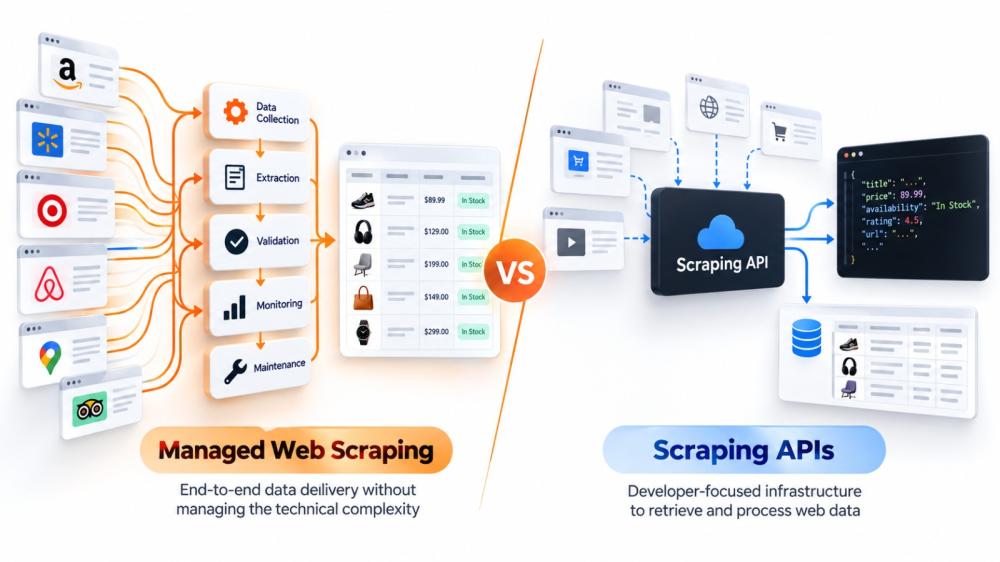
What a Managed Web Scraping Service OwnsA managed service changes the boundary of responsibility. Instead of giving the customer only software or an endpoint, the provider may take responsibility for a larger portion of the collection workflow.
The customer still owns important decisions. It must define the business use case, required fields, acceptable quality, refresh frequency, source coverage, and compliance expectations. A managed model shifts operational responsibility; it does not remove the need for clear requirements. Cost: Compare Total Cost of Ownership, Not Just Tool FeesCost comparisons are often misleading because they compare a managed service invoice with the price of an open-source framework or cloud instance. Software can be free while the operating model remains expensive. A more useful comparison is total cost of ownership.
In-house TCO = build effort + infrastructure + maintenance + QA + incident response + ongoing engineering time. Managed TCO = setup + recurring service costs + scope changes + internal oversight and integration. For small, stable projects, in-house collection can be economical. For large or frequently changing source portfolios, maintenance and engineering opportunity cost can become the dominant expense. The right comparison is therefore not 'free code versus paid service' but 'total operating model versus total operating model.' Reliability: Who Owns Failure?Web scraping systems operate against websites the data collector does not control. That means failures are inevitable at some point. The practical difference between models is who detects the problem, who repairs it, and how quickly the system returns to acceptable output. Common failure scenarios include:
With an in-house system, internal engineers investigate and restore the pipeline. With a managed model, the provider is expected to monitor and maintain the collection workflow according to the agreed service scope. Managed scraping does not eliminate technical failure; it changes who owns the operational response. Data Quality: Scraping Pages Is Not the Same as Delivering Usable DataA collection job can technically succeed and still produce poor business data. For example, an extraction may return 50,000 records while quietly missing price fields on 12 percent of them or duplicating products after a site change. A production-quality workflow should therefore separate several stages:
Useful data quality checks can include:
This is where the distinction between a scraper and a data service becomes important. The business usually needs trustworthy records, not merely successfully downloaded pages. Speed to ProductionIn-house collection gives a skilled team complete freedom over architecture and implementation, but the team may still need to build production infrastructure around the extraction logic. A typical internal path might look like: research -> prototype -> infrastructure -> testing -> QA -> monitoring -> production A managed engagement may instead follow: requirements -> representative sample -> validation -> production workflow -> recurring delivery The advantage is not that managed services are always faster. It is that they reduce the amount of scraping-specific infrastructure the customer's engineering team must create before dependable data can reach the business. Control and CustomizationControl is one of the strongest arguments for an in-house approach. Internal teams own the code, architecture, deployment model, release schedule, observability, and source-specific behavior. For products where scraping logic is a core part of the intellectual property, that control can be strategically important. Managed services can still be highly customized. Customers may specify fields, sources, refresh schedules, schemas, validation rules, and delivery destinations. The difference is that the implementation itself is primarily operated outside the customer's engineering stack.
Scalability Is More Than Adding ServersScale can increase along several dimensions at once:
An internal system can absolutely scale, but the company must plan and operate that scaling. In a managed model, the provider absorbs more of the source and infrastructure complexity within the agreed service boundaries. The real question is not whether either model can scale, but which team should own the scaling work. When In-House Web Scraping Makes More SenseIn-house scraping is often the better choice when control and technical ownership create direct business value. It may be a strong fit when:
For these teams, outsourcing too much of the collection layer may reduce flexibility or make important product behavior dependent on an external provider. When Managed Web Scraping Makes More SenseA managed model becomes more attractive when the business value sits in the data rather than in owning the scraping infrastructure. It may be a stronger fit when:
Organizations that primarily need reliable structured data rather than another infrastructure layer to maintain may evaluate managed web scraping services that combine extraction, monitoring, validation, maintenance, and delivery within a managed workflow. Do Not Ignore the Hybrid ModelThe decision does not have to be all-or-nothing. Many organizations can benefit from a hybrid operating model. For example, a team might:
A hybrid model can preserve control where it matters while reducing the maintenance burden of less strategic collection work. An 8-Question Decision FrameworkBefore choosing a model, answer these questions as concretely as possible. 1. Is scraping a core product capability?If the scraping layer directly powers the product and represents important intellectual property, internal ownership is more valuable. 2. How many sources must be maintained?A small number of stable sources is very different from dozens or hundreds of frequently changing websites. 3. How frequently must data refresh?More frequent collection increases infrastructure, monitoring, and failure-recovery requirements. 4. How complex are the sources?Dynamic rendering, location-specific experiences, sessions, marketplace sellers, and frequent redesigns all increase operating complexity. 5. What happens when the pipeline fails?If stale or incorrect data affects pricing, analytics, AI systems, customers, or revenue decisions, monitoring and response become business-critical. 6. How much engineering capacity is available?A technically feasible project may still be the wrong internal investment if it displaces higher-value product or data work. 7. How important are normalization and QA?If raw extracted fields require substantial cleaning before use, compare the complete data workflow rather than only extraction. 8. Does infrastructure ownership create strategic value?If the company would gain little advantage from owning crawlers, proxies, browser workers, and monitoring systems, a managed or hybrid model may be more efficient. Comparison Matrix
Example Business Scenarios
Frequently Asked QuestionsIs managed web scraping cheaper than building in-house?Not always. The answer depends on total cost of ownership. In-house costs can include engineering, infrastructure, monitoring, QA, maintenance, and incident response. Managed services add provider fees but reduce some scraping-specific operational work. Small stable projects may be cheaper internally, while large or changing source portfolios can shift the economics. When should a company outsource web scraping?Outsourcing becomes more attractive when the company primarily needs dependable structured data, internal scraping maintenance is consuming engineering time, source coverage is expanding, or the workflow requires recurring monitoring and validation. What does a managed web scraping service usually include?Scope varies by provider, but a managed service may include source assessment, extraction development, infrastructure, monitoring, maintenance, normalization, quality checks, and structured delivery. Buyers should confirm exactly which responsibilities are included before comparing providers. Is in-house web scraping more flexible?It usually provides the highest degree of technical control because the company owns the code and infrastructure. Managed services can still support custom sources, schemas, cadence, and delivery, but implementation is governed by the service model and agreed scope. Can managed web scraping handle JavaScript-heavy websites?Many managed providers support browser-based or JavaScript-rendered sources, but capabilities vary. Feasibility should be validated against the specific websites, fields, refresh requirements, and interaction complexity involved. Can companies combine internal scraping with managed services?Yes. A hybrid model is often practical. Companies can keep product-critical or proprietary sources in-house while outsourcing high-maintenance, long-tail, or rapidly expanding source coverage. Final TakeawayThe right choice depends less on whether your team can build a scraper and more on whether owning the complete scraping operation creates business value. In-house systems offer maximum technical control and can be an excellent fit when collection is central to the product or when the organization already has specialized engineering capability. Managed services are often more attractive when the business mainly needs dependable structured data and would rather not own crawler infrastructure, source maintenance, monitoring, and quality operations. A hybrid model can combine both approaches where different sources have different strategic value. Before deciding, compare the full operating model: who builds, who maintains, who detects failure, who validates the data, and who is accountable when a source changes. That comparison is usually more useful than comparing software prices alone. Contributor: KVETOIQ - managed web data, custom web scraping, data extraction, and structured data delivery. | ||||||||||||||||||||||||||||||||||||||||||||||||||||||||||||||||||||||||||||||||||||||||||||||||||||||||||||||||||||||||||||
|
 Managed Web Scraping vs In-House Scraping: Cost, Reliability & When to Outsource
 |